Showing posts with label Vikings at AYPE. Show all posts

04 June 2016

Poulsbo AYPE Viking #6: Halvor Holte

Halvor O. Holte was part of the "Viking" contingent to represent his community in the Norway Day parade at the 1909 Alaska Yukon Pacific Exposition (AYPE) in Seattle. See the explanatory blog entry for this series: Poulsbo Vikings at the Alaska Yukon Pacific Exposition, 1909.

It is not known whether or not Halvor Holte actually lived in Poulsbo, Washington, or how he was selected as a representative member of that community for the AYPE.  By 1913, the Seattle City Directory listed Holte as a watchmaker, so it is likely he was living in Seattle by 1913.

Holte was born on October 7, 1881 in Rindal, Norway.  Having immigrated from Norway in 1906, he was a more recent arrival than the other Poulsbo "Vikings" who participated in the 1909 AYPE Norway Day activities.  Holte, a naturalized citizen, was also younger than the others.  He was about 27 years old when the photograph to the left was taken.

Holte had the dubious distinction of having to register for two United States drafts in his lifetime.  His registration card for World War I lists his brother, Nils Holte, from Bellingham, as the next-of-kin, so it is assumed he was unmarried at that time.  Tall and slender, he had brown eyes and brown hair., and it is very probable that the mustache he sported in his Viking photograph was a real one.  By 1918, he lived at 921 Water Street in South Bend, Washington.
Holte registered for the World War II draft in 1942, when he was about 60 years of age.  At that time, he still lived in South Bend, with his wife, Dora, from Montana, and their son, George.  At some point in his professional career, he began advertising himself as a "jeweler" instead of "watchmaker," as the add from the 1958 Raymond High School yearbook shows.

Fortunate to be very long lived, Holte passed away at age 97 in Pacific, Washington.


Sources:

--Seattle City Directory, 1913
--U. S. Federal Census, South Bend, Pacific, Washington, 1930
--U. S. School Yearbooks, 1880-2012, Raymond High School, Raymond, Washington, 1958
--U. S., World War I Draft Registration Cards, 1917-1918, Halvor Holte
--U. S., World War II Draft Registration Cards, 1942, Havlor Holte
--Washington Death Index, 1940-1996
_________________________
Chery Kinnick

Poulsbo AYPE Viking #8: John J. Twedt

John J. Twedt, of Poulsbo, Washington, was part of the "Viking" contingent to represent his community in the Norway Day parade at the 1909 Alaska Yukon Pacific Exposition (AYPE) in Seattle. See the explanatory blog entry for this series: Poulsbo Vikings at the Alaska Yukon Pacific Exposition, 1909.

John J. Twedt was born in Norway on January 18, 1874, and came to Washington State by way of Iowa.  He immigrated to America in about 1888, and became a naturalized citizen.  In 1910, while still a single man, he rented a house along with his sixteen years-younger brother, Chris Twedt, who became known for being a player on the local baseball team.

On his World War I draft registration card for 1918, Twedt was noted as a man of medium height and build, with brown eyes and dark hair.  His occupation was listed as "auto driver."  An ad running in the Poulsbo Record on June 27, 1918  indicated that he would answer calls for driver service, day or night.

By 1920, Twedt was working as a barber in Poulsbo.  The family resided on Second Street, just a few doors down from Peter Iverson, a fellow AYPE Viking participant.  Twedt lived with his spouse, Amanda, and their two daughters:  Alice Aletta (Twedt) Seely, and June N. (Twedt) Davis.

Five years following Twedt's involvement in the Alaska Yukon Pacific Exposition, a fire devastated about a third of the Poulsbo business section, including his own barber shop.  The hardy town business owners did not take very long to re-establish themselves, by any means possible, with Twedt setting up his barber shop temporarily in A. N. Nelson's machine shop.

John Twedt reportedly died on June 24, 1958 in Bremerton, Washington.


Sources:

--"Remembering the Great Fire of 1914."  Kitsap County Herald, September 15, 2014,  http://www.northkitsapherald.com/news/274914941.html?mobile=true (accessed June 2, 2016).
--U.S. Federal Census, Poulsbo, Kitsap, Washington, 1910, 1920, 1930, 1940.
--World War I Draft Registration Cards, U.S., 1917-1918, John J. Twedt, Ancestry.com, Registration State: Washington; Registration County: Kitsap; Roll: 1991652.
_________________________
Chery Kinnick

Poulsbo AYPE Viking #1: Stener Thorsen

Stener Thorsen, of Poulsbo, Washington, was part of the "Viking" contingent to represent his community in the Norway Day parade at the 1909 Alaska Yukon Pacific Exposition (AYPE) in Seattle. See the explanatory blog entry for this series: Poulsbo Vikings at the Alaska Yukon Pacific Exposition, 1909.


Stener [Stenar] Thorsen was born in about 1850 and immigrated to the U.S. from Heidalen, Gudbrandsdalen, Norway in 1869, together with his three brothers:  Iver, Paul, and Ole. Stener and his wife, Ragnild, were married in about 1879, the year after Ragnild arrived in America.

A Poulsbo pioneer, Thorsen was one of two earliest settlers in Big Valley, on Valley Road, about a mile north of the town of Poulsbo, Washington.  Deeds owned by a friend and neighbor, Fred Frederickson, show that Thorsen had his property as early as 1879.  Being in all probability the first settler in the valley, perhaps that is why he won the AYPE "Viking #1" position in the 1909 photographs.

Thorsen was a logging operator, and the land he chose was optimally situated near the head of Liberty Bay, which allowed easy access for loggers who needed to float out their logs.  He developed an extensive farming operation, and maintained a large market garden on his farm.  Thorsen's produce included an acre of oxheart carrots that were marketed at the company store in Port Gamble, or peddled to ships waiting in the bay to take on lumber.  He also raised potatoes, and picked from cherry trees on his property during market season.

Stener Thorsen was a community minded man, as many early Norwegian-American settlers were, and he often served as an official in precinct elections.  He also took an interest in the state of Poulsbo's schools, church, and roads.  He died on September 28, 1931, the day before his 81st birthday, and was buried at the First Lutheran Church Cemetery in Poulsbo, Washington.
 
Stener Thorsen farming (date unknown).  Image was uploaded
 to Ancestry.com by member "boggiedog7" on April 27, 2008.

Sources:

--Driscoll, Judy and Sherry White.  Poulsbo, Images of America series (Arcadia Publishing:  Charlestown, South Carolina, 2013).
--Poulsbo Centennial Book Committee.  Poulsbo:  Its First Hundred Years, compiled and edited by Rangvald Kvelstad (Centennial Book Committee:  Poulsbo, Washington, 1986). 
--U. S. Federal Census, Poulsbo, Kitsap, Washington, 1910.
--U. S. Find-a-Grave, Stener Thorsen.
_________________________
Chery Kinnick

17 September 2015

Poulsbo AYPE Viking #2: Peter Iverson

 
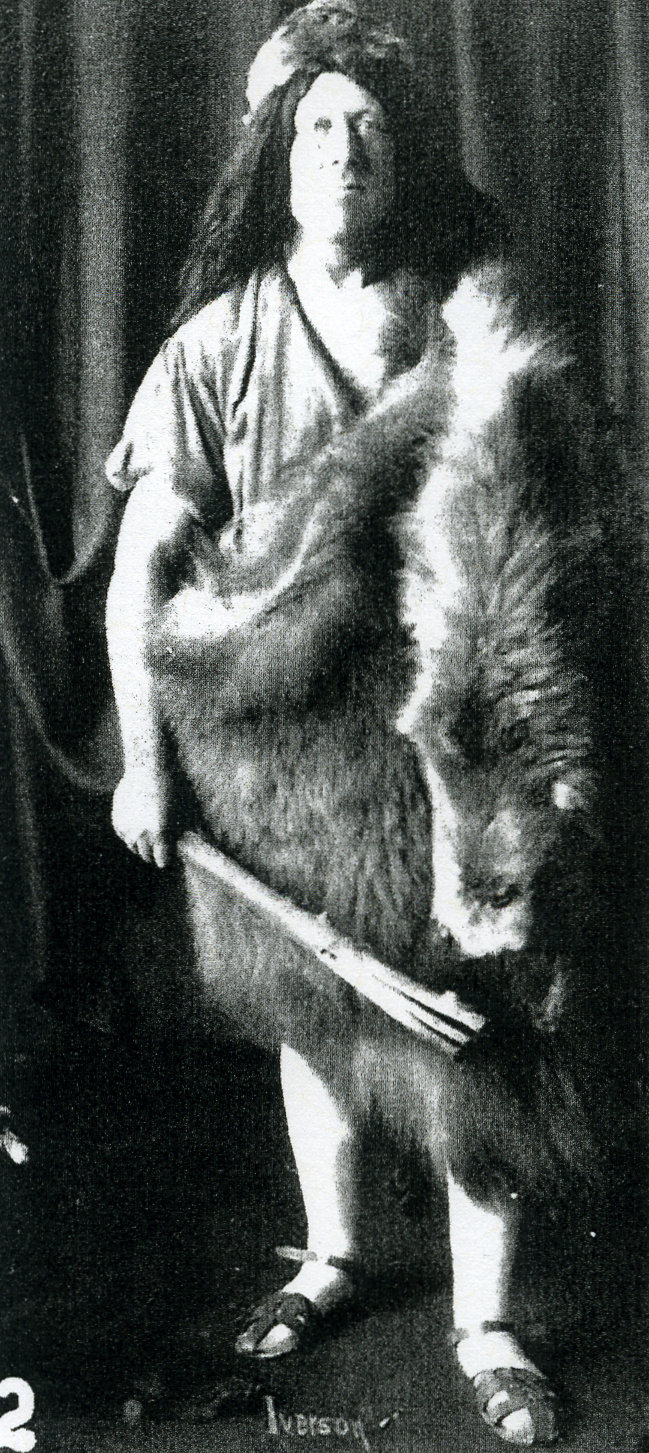
Peter Iverson, Mayor of Poulsbo, Washington, was part of the "Viking" contingent to represent his community in the Norway Day parade at the 1909 Alaska Yukon Pacific Exposition (AYPE) in Seattle. See the explanatory blog entry for this series: Poulsbo Vikings at the Alaska Yukon Pacific Exposition, 1909.

Peter Iverson dressed as a
5th Century Viking
Beneath the bear skin and tough Viking demeanor displayed in Iverson's 1909 photograph (left), lay the heart and soul of a journalist and politician.  Poulsbo Viking #2 was a newspaperman for many years.  He also served as mayor, and as a senator representing the counties of Island, Kitsap, and Mason.

Peter Iverson was born on February 25, 1861 in Odda, Hardanger, Norway, and became a naturalization citizen of the United States.  After immigrating, he lived in Minnesota and Illinois before settling in Iowa, where he was a student at Humbodlt Academy and Cornell College.  It was there he published the Bode Bugle with his wife, Josephine.  In 1896, he visited Poulsbo, Washington on the west coast and was impressed by Dogfish Creek, a salmon bearing stream.  He returned to Iowa and convinced Josephine to move to the beautiful, Nordic-like Puget Sound area.  The couple packed up their two daughters, Julia and Eleanor, and three sons, Edward, Christie, and Henry, and arrived in Poulsbo, Washington in 1900.

Once in Poulsbo, the couple re-established their Iowa newspaper as the Kitsap County Herald, which began printing on February 1, 1901.  The paper was not able to support the family at  first, so Iverson, who worked as publisher and editor, also became an independent steam boat operator, using the Josephine L to work at log towing and other lumber enterprises to bring in extra income.  While Iverson was away from home on business--whether maritime or newspaper-related, or other pursuits--his family was required to get the paper out on a weekly basis.  Josephine served as a journalist and drew from her newspaper experience back in Iowa, and with the help of the children they managed the Friday publication deadlines.

It took the Iversons about a week to get each issue out due to the involved printing processes at the turn of the 20th century.  Setting type backwards before the printing could begin was a slow and lengthy process, and everyone had his or her tasks to do in order to meet the print deadline.  Iverson's daughter, Eleanor, recalled that at age five, she was assigned the task of picking up newspaper type that had fallen on the floor.  One time in the early days of the publication, a disaster resulted in a missed printing when a printing form fell to the floor as it was being transferred to the press.  This jumble on the floor was called a "pi" in old journalism terms, and after that day the Iversons referred to it, and any other day when all things went wrong, as a "pi day."  The family sold the newspaper in 1936.

In addition to his newspaper business, Peter Iverson was elected mayor of Poulsbo shortly after its incorporation, and he held the position for twelve years.  In 1913, he won a senatorial seat in the state legislature and held it for several consecutive terms.  As Senator, he fought for good roads, aid with clearing isolated land for farmers, and sponsored other measures for the development of Kitsap County.  Here is a link to a photograph of Peter Iverson, among the members of the Washington State Senate in the Legislative Building in Olympia, Washington, ca. 1911-1913.  In 1940, the family resided on Front Street, where they owned a home.  Iverson passed away at age 85 on February 13, 1946.

Sources:

--Kitsap County Historical Society.  Kitsap County History:  A Story of Kitsap County and Its Pioneers
(The Society:  Poulsbo, Washington, 1977).

--"Peter Iverson Founder of Herald, Taken by Death." Obituary for Peter Iverson, February 1946.
--"Society hears story of papers beginning."  North Kitsap Herald, June 10, 2008:  http://www.northkitsapherald.com/news/19741684.html# (accessed 9/17/2015).
--U. S. City Directories, Bremerton, Washington, 1909-1936
--U. S. Federal Census, Poulsbo, Washington, 1910-1940
--University of Washington Department of Journalism.  The Washington Newspaper:  A Publication Dedicated to the Study and Improvement of Journalism in Washington, v.7-8 (University of Washington Department of Journalism; Washington Press Assoc.:  Seattle, Washington, 1921).
--University of Washington, Special Collections.  Peter Iverson papers, acc. #0218-001.
--Washington State Death Index, 1940-1996
_________________________
Chery Kinnick

31 January 2013

Poulsbo AYPE Viking #4: Nels Sonju


Nels Sonju,  Norwegian immigrant, was part of the "Viking" contingent to represent the community of Poulsbo, Washington in the Norway Day parade at the 1909 Alaska Yukon Pacific Exposition (AYPE) in Seattle.  See the explanatory blog entry for this series:  Poulsbo Vikings at the Alaska Yukon Pacific Exposition, 1909.

Nels Sonju, dressed as a 5th Century
 Viking in 1909 (Rangvald Kvelstad,
 Poulsbo:  Its First Hundred Years).
I first became interested in Nels Sonju (1864-1923), a Norwegian-American businessman, entrepreneur, and adventurer, while searching for information about one of his daughters. I learned that the Sonju family from Poulsbo, Washington came from a Norwegian background, and discovered Sonju's activities relating to the AYPE.

Nels Sonju immigrated from Norway in 1879, first residing in Bayfield, Wisconsin, and then Troy, Wisconsin.  He married Petra A. Soli in Pierce County, Wisconsin, on March 20, 1884.  The couple had four children:  Annie M., born in about 1897, in Wisconsin; Sarah, born on April 6, 1891, at Washburn, Bayfield, Wisconsin; Howard Melvin, born on January 1, 1898, also at Washburn; and Norman Rudolph, born on June 6, 1902, at Hudson, St. Croix, Wisconsin.

Several years before the 1909 AYPE, Nels and Petra Sonju moved their family to the Seattle area in Washington State, accompanied by other family members from the Bayfield, Wisconsin area.

Nels Sonju built the Grand View Hotel along the Poulsbo waterfront, which served as the main source of income for his family.  He maintained a horse drawn taxi service as a sideline, and starting in 1918, operated an auto taxi service, the Vinland-Poulsbo mail and stage line.  He brought the mail from the steamer in Poulsbo to the post office in Vinland, and then transported passengers, mail, and freight back to Poulsbo.

The Grand View Hotel was torn down in about 1970 in order to provide a site for the new Sons of Norway Grieg Hall.  As an individual who was interested in the development of his community, Sonju served as a director for the area's first telephone company, the Poulsbo Rural Telephone Company, incorporated in 1907.  Along with the other original stockholders, Sonju was responsible for the maintenance and line work.  He was also a charter member of the Poulsbo Lodge #44, Sons of Norway, organized in 1916.  The stated objective of the order was to foster and promote "all that is good in the Norwegian heritage."

Old postcard of the Grand View Hotel in Poulsbo, ca. 1910.


Advertisement from the front page of the Kitsap County Herald, April 12, 1918.


Nels Sonju had other adventures.  He figured prominently in George C. Teien's recounting of his Klondike adventures in the Teien Tales:  I Enter the Alaska Fur Trade.

The Sonjus' second daughter, Sarah, worked as a color artist for various Seattle photographers, including well-known Asahel Curtis. Curtis was known for documenting Washington's natural resources and related industries, as well as early historic events. While working at the Curtis studio, Sarah met Lawrence Denny Lindsley, nature photographer and grandson of Seattle founding pioneers David and Louisa Denny.  At age 53, Sarah married Lindsley in 1944.

Norman Sonju, youngest son of Nels and Petra, made a name for himself on the rowing team at the University of Washington, where he attended in the late 1920s. Norman studied business administration, and was also a member of Sigma Phy Epsilon fraternity, the Oval Club, Varsity Boat Club, and Captain Crew. As a graduating senior, he was a student assistant to Coach Rusty Callow. After graduation, he then served on the faculty for a couple of years, and coached the crew at Cornell University from 1936-1946. He found national recognition as a rowing coach for the University of Wisconsin, and for his career success at home and at an Olympic meet in London. After his retirement in 1946, Norman Sonju returned to the Poulsbo, Washington, where he had spent his childhood years.


Nels Sonju (1864-1923), grave marker at the First Lutheran
 Church Cemetery in Poulsbo, Kitsap County, Washington
(Find a Grave)

After Nels Sonju died in 1923, his widow, Petra, moved to Seattle and lived at 1625 E. Madison while their youngest son, Norman, attended the University of Washington.  By 1932, she was living with her daughter, Sarah, a photography color artist, at 6553 Palatine Avenue.  Petra Sonju passed away on August 6, 1943, at the age of eighty.


Sources:

--"Can you heareth me now? Poulsbo at the --Turn of the Century Pushed Hard for Telephone Service." Kitsap Sun, Nov. 2, 2009:  http://www.kitsapsun.com/news/2009/nov/02/can-you-heareth-me-now/?print=1
--Driscoll, Judy and Sherry White.  Poulsbo, Images of America Series (Arcadia Publishing:  Charleston, South Carolina, 2013).
--Evergreen/Washelli Cemetery Records; Seattle, Washington.
--Findagrave.com
--Kitsap County Herald, April 12, 1918; p.1 (Grand View Hotel advertisement)
--Kitsap County Historical Society Book Committee.  Kitsap County History.  Kitsap County Historical Society:  Seattle, Washington, 1977).
--Rangvald Kvelstad.  Poulsbo:  Its First Hundred Years (Poulsbo Centennial Book Committee:  Silverton, Washington, 1986).
--U. S. City Directories, 1821-1989;  Seattle and Bremerton, Washington
 --U. S. Federal Census, 1900,  for Troy, Saint Croix County, Wisconsin
--U. S. Federal Census, 1910-1920,  for Poulsbo, Kitsap County, Washington

--U. S. General Land Office Records, 1796-1907
--Washington Death Index, 1940-1996
--Wisconsin Marriages, pre-1907
--Wisconsin State Census, 1895

articled revised 6/3/2016
________________________
Chery Kinnick

31 August 2012

Poulsbo Vikings at the Alaska Yukon Pacific Exposition, 1909

During the summer and early autumn of 1909, Seattle sponsored Washington State's first World's Fair on the current site of the University of Washington campus.  The fair was called the Alaska Yukon Pacific Exposition (AYPE), and it celebrated twelve years of local prosperity following the 1897 Alaska Gold Rush.   Many days at the fair had special themes that honored ethnic communities, organizations, or professions.  As a nod to the area's large Norwegian-American population, "Norway Day" was held on August 30.

Poulsbo, Washington was one of the Puget Sound localities most heavily populated by Scandinavians:

On a sunny slope slowly rising from the merry sheet of golden water, stands the town of Poulsbo, in Kitsap County, about 25 miles northwest from Seattle.  Here and there a green nose is pushing itself into the brine as trying to contest with the elements of the deep.  Sweet melodies spring from the laughing ripples, and sail on the wings of lazy zephyrs to cheer the ears of the village.  This muscial bay is a natural abode for Scandinavians who are wont for the songs of happy fjords... [Kitsap County History, Book II--North Kitsap, p.34.]

The town of Poulsbo sent twelve prominent citizens (one for each year of prosperity) to participate in a 500-plus person Norway Day parade representing nine periods of Norwegian history at the Exposition.


Images:  Poulsbo Centennial Book Committee, Poulsbo: Its First Hundred Years, compiled and edited by Rangval Kvelstad (Centennial Book Committee:  Poulsbo, Washington, 1986).


Many years after the AYPE, in preparation for the publication of a local history, a member of the Kitsap County Historical Society sent a worn set of photographs of the twelve 1909 Poulsbo Vikings to a photography studio for refurbishing.  The bill that was returned with the refurbished photographs of the men, who had posed wielding clubs and wearing bear skins and leather sandals,, read:  "Reconditioned:  12 Cave Men." [Kvelstad. Poulsbo, Its First Hundred Years, p.67]

Judging by the appearance of the Viking costumes, it is likely that the twleve men represented the first period of Norwegian history while carrying the Poulsbo banner in the AYPE Norway Day parade.  Their pre-historic appearing costumes were meant to showcase the "warriors of the fifth century, clad in sandals and sporting long hair and beards, representing Norsemen and Visigoths capturing Roman soldiers." [HistoryLink.org]

I became interested in finding out more about these twelve intriguing Poulsbo cave men, er... I mean "Vikings," so I decided to research them for a series of blog articles.  The fearless twelve are:  Stener Thorsen, Peter Iverson, George Teien, Nels Sonju, Carl Breivig, Halvor Holte, Christian Garthe, John Twedt, Chris Lakeness, Tenander Iversen, Ole Hanson, and Ole Ellefson Espelund.  First up will be Viking #4:  Nels Sonju.  Stay tuned!


See also:

Poulsbo AYPE Viking #1:  Stener Thorsen
Poulsbo AYPE Viking #2:  Peter Iverson
Poulsbo AYPE Viking #4:  Nels Sonju
Poulsbo AYPE Viking #6:  Halvor Holte
Poulsbo AYPE Viking #8:  John Twedt

Sources:

--HistoryLink.org, Essay 8923: "Alaska-Yukon-Pacific Exposition in Seattle celebrates Norway Day on August 30, 1909."
--Kitsap County Historical Society.  Kitsap County History.  Seattle:  Kitsap County Historical Society, 1977.
--Kvelstad, Rangvald.  Poulsbo:  Its First Hundred Years.  Silverdate, Washington:  Poulsbo Centennial Book Committee,
1986.

_________________________
Chery Kinnick